-Pagan Bearing Palm Branch

I have traveled throughout the lands under Caesar Augustus and the world is much the same; the rich rule and justice is an uncertain thing and there is more war than peace. Here among these people who call themselves Israel, it is no different. I have studied many gods and what is said of them and this god of the Jews seems but little different from the rest, except for his aloneness. They call me gentile here which means that I believe in many gods. The Jews believe in one only, a male of whom they are prohibited of making an image, or even saying his name. Yet when they tell of him he seems much like our own Zeus or Jupiter — jealous, vengeful, just, arbitrary, blood-thirsty, kind to his own, but unlike Zeus, without a goddess to keep him sweet. Indeed, unlike our Zeuz, he does not seem to like women much. They call their god Father, but how is there a father without a mother unless it be holy Gaea, the Earth herself? And in truth, she has her Sun. These Jews do not paint nor make clay or wood or stone images of their god but idolize instead their strange ideas of him.
Now I find myself in Yerusalem for the Spring celebrations of the Jews. Yerusalem is lovely this time of year and festive and I cannot but be joyful holding a palm branch someone thrust into my hand. A goodly crowd is welcoming a young prophet I have been observing for some odd years. Yeshua they call him, Iesous in our Greek. Son of Yoseph the carpenter, he comes from the countryside, the village of Nazareth, having left behind his craft to teach. He is an unusual man by any count and wonders have been ascribed to him such as changing water into wine, and walking upon water, and raising up the dead, casting out demons, healing, feeding a multitude.
I do not know. I have been present at only one of such purported wonders, a time he is supposed to have fed the crowd. He spoke atop a small hill and people came to hear him from about the countryside, a good sized crowd (though not the myriads that have grown with each telling.) Yes, he spoke long and the folk overstayed their intentions and had to eat. But let us remember, these are country folk, peasants and fishermen, who know well enough to carry food in their knapsacks when they go on an outing, coarse bread, salted or dried fish, fruit. All in all, I dare say there was enough to share. It is said this Iesous multiplied but seven loaves of bread and a few fishes to feed them all. Perhaps; the Earth is full of wonders, but I doubt it. If miracle you can call it, it was enough that he opened the hearts and generosity of the people to share their food with those that had none. I suppose that is miracle enough.
This Iesous, unlike the god of his people, likes women much and frequents their company, consorting with women of even the most lowly and despised among the Jews, like the Samaritans and such. Indeed particularly close to him is one Maryam, a woman of Magdala said by some to be a prostitute, a social outcast here, not like the holy women in our temples devoted to Divine Aphrodite. I doubt not but there is an amorous tie between Iesous and this Maryam the Magdalene who has nothing of the whore.
Still, it is apparent that he likes men just as well. He always has about him a small group of favorites that hang upon every word he says, worshipping the ground he walks upon. Of these, his very favorite is a comely youth named Yohanan, for obvious reasons called “the beloved.” It is apparent that they are enamoured each of the other. These men are for the most part simple folk, peasants, fishermen, artisans, tradesmen, illiterate, though some I am sure have some learning, certainly at least in the lore of their religion, some like Iesous probably village rabbis.
They do not have much, indeed this Iesous is not much popular among the rich, the polite classes. He consorts too much with women and children, with the despised, the poor, the homeless, the sick, the unlearned, the outcasts. The fact is that to speak for the unfortunate this Jew puts to test the laws of his ancient cult. I have seen him save a poor woman, caught in adultery, from being stoned to death, according to the law of the Hebrews, by shaming the villagers with their own transgressions. He preaches that the homeless must be sheltered, that the sick must be healed, that the ignorant must be taught, that the foreigner and outcast must be embraced, the prisoner visited. The bone of his teaching is love; the meat is justice and peace.
I have spoken with his mother Maryam and his brothers Yacob and Yoses and Shimon and Yehudhah, and his sisters, his family whom he has abandoned, and they think him daft. Indeed his kinsmen try to restrain him as mad. But I have heard him speak and he makes much sense. He speaks well and strongly, but there is a sting in his words to the powerful. Iesous does not hesitate to call them hypocrites, unfaithful stewards, and such. In his eyes, they are not so much the keepers of the law, but abusers of it. And indeed it would appear so. They grow fat on the suffering of others and do not honor our mother Gaea The Earth.
Another thing is that he does not much believe in the virtue of labor, of work to produce what serves no purpose but to produce and produce. I have heard him say that the Earth already holds enough to sustain us pointing out that the flowers of the fields are more beautiful than the luxurious vestments of Shelomon the legendary king of the Jews. Iesous certainly respects the honest work of the peasants, the fishermen, the artisans, the tradesmen, but he abhors usury, greed. I have seen him in anger upset the counting tables of the money changers in the temple, which caused much outrage among the bankers and such, not to mention the priests. I have heard him tell the young heir of a wealthy family that it is more difficult for a rich man to enter paradise than it is for a camel to pass through the eye of a needle. (I believe they call the narrowest gate to the city “The Needle’s Eye.”) No, the rich and the powerful do not much like Iesous.
He is a gentle man this young preacher who is fond of teaching through stories whose principle message is: “you were invited to party but you did not come.” I would not put it past him, if he could, to change water into wine. He can certainly change the hearts of his listeners to something sweeter and more good. Just as he tries to change the image of Jehova (the unspoken name of their harsh god) into the gentler, kinder image of his own. Although there is little effeminate about this Iesous still there is much that is feminine in his nature. I believe he is trying to give his god the one thing Yehova really lacks — a mother, or a sister, or a wife.
He treads a dangerous path, does Iesous, tampering with the stern, one-dimensional image of his nation’s god. Judge not lest thou be judged, he says, but I fear he is much judged already. You without sin cast the first stone, he challenges, and I fear there are already many all too willing to stone him. It is dangerous to broaden the dimensions of the gods, especially those that exist only in people’s heads, defined in books, their laws minutely prescribed (our own Socrates was killed accused of contempt for the gods.) And Iesous does just that. I have heard him say that he brings a new commandment to supersede all previous law: love god above all else and your neighbor as you do yourself. And he did not specify only your Jewish neighbor, but included all us gentiles too. Another time, he said that the law was made for humankind and not humankind for the law. Dangerous stuff.
What the powerful really fear is that a Socrates, a Iesous, and others of their kind may incite the people to question, to think. Thought leads to judgement, judgement to demand. And demands perhaps to action. Before a people aroused, even Caesar must quake. The meek just may inherit the Earth, as Iesous says, but first the meek must find their voice and speak. He has just said that if these should remain silent, the stones themselves would cry out.
The day is beautiful and indeed I do not mind holding this palm branch. I think I too am a bit in love with this beautiful man. There is so much kindness and joy in him — and truly so much courage. The crowd cries its hosannas, hosannas jubilantly as he enters the city to celebrate their ancient Spring celebration, the ritual feast marking their freedom from slavery. It is a joyous time and the people are all glad that it is Spring. There are flowers among the palm fronds strewn before the hoofs of the little gray ass Iesous rides through the street. By Kore, it is a glorious day to be alive. We smile at one another and shake hands and hug — Jews and the Greeks, Egyptians, Syrians, Arabs, Romans, among them, representative of all us gentiles. Many carry palm fronds only because someone pressed them into their hands and they only want to join in the festivity. It is a glorious day on which to wave palm branches.
Still, I worry for him. He speaks his truth freely and the priests, the rich, the powerful are far from pleased. What if more people listened to him, truly listened? What if they bespoke and followed what he teaches? What if truly the people desired justice and peace? What if? Then, by the Graces, truly it would be glorious and I would be content to wave a palm frond every day I live. But I am not an idolatrous priest, nor am I rich, nor powerful — greed and lust for power is a terrible disease. And there are the fearful, the superstitious, the stupid. The people are of divided opinion; some would die for him, some would stone him for blasphemy, some teeter, change opinion one moment to the next. One hears rumors and many are not pleased. This Iesous, I do not think he will live long. He treads a dangerous path. I, the Hellene, the gentile, the pagan, fear for him. The rich and the powerful, they do not love him much.
But it is about us, the people that I wonder. Our rulers indeed are hypocrites — liars and cheats, thieves and scoundrels, war-mongers, that hold the Earth for little and twist the law that would protect the common good to their own advantage, growing evermore more rich and powerful at our expense. And yet, several times already the crowd itself would have killed Iesous. It is not good by any measure.
Today we gather and wave palm branches and yell, “Hosanna! Hosanna!” in joy
of Spring, and Iesous, and each other, but this joy that should be the root of our empowerment tomorrow will dissipate and our burdens will not be a grain of wheat more light. Unless, unless finding our voice we demand justice and peace and veneration of holy mother Earth.
These people say humankind was expelled from an earthly paradise and that we must look for a paradise on the other side of death. But it is here, in this life that we hunger and thirst, that we bear the cold and the heat, that we suffer the results of ignorance and fear, that we war and kill one another — and above all, it is here that we love, enjoy the sun and the waters, and the taste of bread and of wine, and the ecstasy of the dance and of music and of art. It is here that we live and if suffering there is, so is it only here that we know what there is to know of joy and happiness.
No, we were never exiled from paradise. We have only spoiled it with our carelessness and greed for wealth and lust for power, and war. Iesous speaks of the kingdom of his Father-God, but the justice and mercy and love he prescribes are of the Earth and no where else.
How long will we tolerate to be ruled by thieves and liars, hypocrites and warmongers? The Hellene, the Athenian in me asks this, impatient with the acquiescence of us, the people. The meek must speak, for our silence is a great betrayal. I worry for us. Will we listen and create his peaceable kingdom of the just and the kind? If enough of us want it, who can stop us? It is up to us.
I do not think Iesous will live long. The rich and the powerful, they do not love him much.
© Rafael Jesús González 2005
(Based on sermon given by the author, Palm Sunday 2002,
at the invitation of its Pastor Dr. Dorsey Blake
at The Church for the Fellowship of All Peoples founded by Dr. Howard Thurman,
San Francisco, California. Author’s copyrights.)

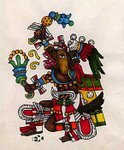

 by Robert Lentz
 -
-


