--
*-------*------*
Pre-Hispanic Mexico  Awed
by the eternal cycle of life and death and the need of sacrifice to
assure the continuation of life, ages before the Spaniards came to the
Americas, the peoples of ancient Mexico, particularly the Nahuas, of
which the Mexica (generally called Aztecs) formed a part, celebrated
the dead in a great feast quite different from the one we know today.
It began on August 8, by the European calendar, and they called it
Micailhuitontli, Small Feast of the Dead, to honor their dead children.
On that morning, the people went to the forest and cut down a tall,
straight tree which they brought to the gates of the city. There, for
twenty days, they blessed the tree and stripped it of its bark.
Awed
by the eternal cycle of life and death and the need of sacrifice to
assure the continuation of life, ages before the Spaniards came to the
Americas, the peoples of ancient Mexico, particularly the Nahuas, of
which the Mexica (generally called Aztecs) formed a part, celebrated
the dead in a great feast quite different from the one we know today.
It began on August 8, by the European calendar, and they called it
Micailhuitontli, Small Feast of the Dead, to honor their dead children.
On that morning, the people went to the forest and cut down a tall,
straight tree which they brought to the gates of the city. There, for
twenty days, they blessed the tree and stripped it of its bark.During those twenty days, they did ritual, sacrificed, feasted, danced, and made offerings to the dead of cempoalxochitl flowers, fire, copal, food, and drink. Then, on August 28, which they called Huey Micailhuitl (Great Feast of the Dead), in honor of their adult dead, they made a large figure of a bird perched on flowering branches out of amaranth seed dough, painted it brightly, and decorated it with colorful feathers. They fixed the dough bird to the end of the tree trunk, raised it in the courtyard of the Great Temple, and honored it with more offerings, singing, copal, dances, sacrifice, and bloodletting.
One hour before sunset, the young noblemen climbed the pole to bring down the figure of the bird. The youths who reached the top first and brought down the dough figure were much honored. They broke it up and passed it out among the people to eat; they called it “flesh of the god.” Then they brought down the pole and broke it up, and everyone tried to take a piece of it back to their homes because it was holy.
The pole and its god-bird on flowering branches must have stood for the mythical Tree of Life that grew in the earthly paradise of Tamoanchan. The blood of sacrifice nourished the Tree of Life, just as Quetzalcoatl, Plumed Serpent, God of Life, shed his blood to create humankind. The ritual of the pole and the flesh of the god honored the fact that life cannot be separated from death; we live and die, and our deaths are the price of living.
Composed of both joy and pain, life is brief and uncertain, its end a question that disquiets the heart. Many poems addressing this sad truth were composed by the Nahua poets, the most famous of whom was Nezahualcoyotl, King of Texcoco, who said:
------------------Is it true that one lives on earth?
------------------Perhaps forever on the earth?
------------------Only a brief instant here!
------------------Even the precious stones chip away,
------------------even the gold falls apart,
------------------even the precious feathers tear.
------------------Perhaps forever on the earth?
------------------Only a brief instant here!
 The
peoples of ancient Mexico created wonderful pieces of sacred art in
which life and death are united. The greatest, perhaps, is the great
Coatlicue (now in the National Museum of Anthropology in Mexico City),
who was at one and the same time terrifying and life-giving, the
goddess of life and death, Earth-Mother of the gods, of humankind:
mother of all. They carved statues depicting Quetzalcoatl, God of
Life, on one side, and on the other, Mictlantecuhtli, God of Death.
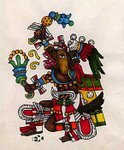
They painted pictures of the gods of life and death indivisibly joined
together, such as the ones in the Borgia Codex, one of the very few
of their marvelous books that survive.
The
peoples of ancient Mexico created wonderful pieces of sacred art in
which life and death are united. The greatest, perhaps, is the great
Coatlicue (now in the National Museum of Anthropology in Mexico City),
who was at one and the same time terrifying and life-giving, the
goddess of life and death, Earth-Mother of the gods, of humankind:
mother of all. They carved statues depicting Quetzalcoatl, God of
Life, on one side, and on the other, Mictlantecuhtli, God of Death.
They painted pictures of the gods of life and death indivisibly joined
together, such as the ones in the Borgia Codex, one of the very few
of their marvelous books that survive.
When someone died, a piece of green-stone was placed in his or her mouth to take the place of the heart. The people believed that most of the dead went to a gray region of shadows called Mictlan (Land of the Dead), led by a little dog through nine levels of trials. Only the warriors killed in battle, the victims of sacrifice, and the women who had died in childbirth went to the realm of the Sun. Suicides and those who drowned, or were struck by lightning, or died of certain illnesses associated with water went to the place of Tlaloc, God of the Rain. Children who died young went to the realm of Ometeotl, Lord/Lady of Duality, to be nursed by a tree in a place called Chichihualcuauhco.
Mexico under Spain
These were the beliefs and the customs of the natives when the Spaniards came to Mexico and conquered Tenochtitlan and the Mexica empire in 1521. Along with the horse, the gun, and disease, the Europeans brought a new religion, Christianity. They called the people Indians and forced them to convert.
Some of the Christian beliefs were similar to the ancient ones: the Sun had demanded bleeding hearts torn from sacrificial victims to pay for life; God the Father required the bloody sacrifice of his only Son to pay for salvation. Coatlicue had conceived the god Huitzilopochtli without intercourse with a man; the virgin Mary had also miraculously conceived Jesus. The Indians ate the “flesh of the god’’ in a piece of amaranth dough; Christians ate the flesh of Christ in a piece of unleavened bread. Indians did penance; so did the Christians.
 But
some of the Christian beliefs were entirely new to the natives, such
as the notion of a place where the dead went as either reward or
punishment for how they had lived their lives: a happy heaven, with
angels, saints, and gods (as they perceived the Trinity) and a painful
hell, full of demons and evildoers. The new Mother of God was not
terrible, as Coatlicue was, but sweet and demure as she stood on the black
obsidian moon in front of the sun and wore the starry night sky for
her cloak. Tonantzin, Mother of Us All, was now called Our Lady of
Guadalupe, an Arabic place-name of Moorish Spain.
But
some of the Christian beliefs were entirely new to the natives, such
as the notion of a place where the dead went as either reward or
punishment for how they had lived their lives: a happy heaven, with
angels, saints, and gods (as they perceived the Trinity) and a painful
hell, full of demons and evildoers. The new Mother of God was not
terrible, as Coatlicue was, but sweet and demure as she stood on the black
obsidian moon in front of the sun and wore the starry night sky for
her cloak. Tonantzin, Mother of Us All, was now called Our Lady of
Guadalupe, an Arabic place-name of Moorish Spain.In spite of their conversion, the native people kept their ancient customs as best they could by adapting them to the demands of the new religion, transferring the old celebrations to the holidays of the Christian calendar. They were forced to change the rituals of their days of the dead but kept as their core the ofrenda (the altar with offerings to the dead). And they still grew (and do to this day) the yellow cempoalxochitl, the cempoal, marigold, known popularly as flor de muerto (flower of the dead), which they used especially to honor the dead. They transferred the two Feasts of the Dead to the Christian Feasts of All Saints and All Souls. (Long before, between the eighth and eleventh centuries, the Christian Church itself had set the Feasts of All Saints and All Souls on the first and second of November, converting the ancient European Celtic feast of the harvest and of the dead, Samhain [sá-win], into a Christian holiday.)

The melding of two cultures
Spanish art offered images of death, similar to those the natives knew, in the martyred Christ and saints, and memento mori (“remember that you die”) images of skulls from the medieval tradition of the Dance of Death. The conquered people merged their old symbols with those of the conquerors. The indigenous cross of the four cardinal points became the Christian cross. The Tree of Life came to refer to the Garden of Eden as well, and eventually gave rise to the beautiful clay árboles de la vida with birds on flowering branches that we know today. The amaranth-dough offerings were replaced by the popular wheat pan de muerto (bread of the dead).
One great change in the Spanish colonial period was the evolvement of humor and whimsy that we today associate with los Día de Muertos and that make the holiday so uniquely Mexican. The Spanish may have brought these elements from the medieval tradition of the Feast of Fools (associated with Carnaval, carne vale, farewell to the flesh), where everything is equal and open to criticism, ridicule, and frivolity. “We are all equal in death and nothing is beyond mockery,” this tradition said. And humor became a part of los Día de Muertos that we know today.
 In
the latter part of the colonial period, the people began making
sugar-candy skulls, brightly decorated with names spelled out in colored
sugar, to exchange as tokens of affection among family and friends.
They placed them on the Día de Muertos altars along with the image of
Guadalupe, the flowers, the water, the bread, the food and drink, the
candles, and the copal that the old ways demanded. They also made toys
in the shape of skeletons and little skeleton dolls of clay and papier
maché that made fun of people and every sort of human activity. They
made playfulness part of the tradition and took from death a little of
its sting.
In
the latter part of the colonial period, the people began making
sugar-candy skulls, brightly decorated with names spelled out in colored
sugar, to exchange as tokens of affection among family and friends.
They placed them on the Día de Muertos altars along with the image of
Guadalupe, the flowers, the water, the bread, the food and drink, the
candles, and the copal that the old ways demanded. They also made toys
in the shape of skeletons and little skeleton dolls of clay and papier
maché that made fun of people and every sort of human activity. They
made playfulness part of the tradition and took from death a little of
its sting.
Another thing that the Spaniards brought was the pasquín (mocking verses scrawled on walls to which passing readers added their own lines and comments). Between 1535 and 1539, the first printing press in America was established in Mexico City, and soon pasquines printed on broadsheets were being pasted on the walls of public buildings. These eventually gave rise to the funny verses called calaveras (skulls, also popularly meaning empty-headed fools), often illustrated with caricatures, through which the people freely criticized and mocked the rich and powerful who ruled their lives. The calavera became a part of the Día de Muertos.
Corridos (ballads in the oral tradition whose themes often focus on current events) had grown to be the popular form of political expression by the time Mexico gained independence from Spain in 1821, and by the late nineteenth century, the corrido and the calavera had almost completely replaced the pasquín. Small print shops throughout the country published the most popular corridos and calaveras on broadsides of colored paper, disseminating information and ideas against the authoritarian Porfirio Díaz regime. The best-known of these presses was that of Antonio Vanegas Arroyo in Mexico City, made famous by the witty poet Constancio S. Suárez and by José Guadalupe Posada, a talented engraver. Posada illustrated the verses written by Suárez, who succinctly put the truth which is the soul of the calavera:
--------------------It is a most sincere truth
--------------------that this adage makes us see:
--------------------only one who was never born
--------------------can never a death’s-head be.
Día de Muertos in the Twentieth Century
 These
are some of the elements of los Días de Muertos inherited by the
twentieth century. With the Revolution of 1910, modern Mexican art
exploded into its own, and the young artists repudiated not only the
French orientation of the Díaz era (1877–1911) but their own Spanish
heritage, idealizing their indigenous past. For the young artists of the
Revolution (José Clemente Orozco, Diego Rivera, Frida Kahlo, and
David Alfaro Siqueiros among them), Posada was the father of modern
Mexican art and quoted his images in their own work. Indeed, many of
Posada’s images (such as his Calavera Catrina) took on the nature of
icons that are now hard to separate from los Días de Muertos.
These
are some of the elements of los Días de Muertos inherited by the
twentieth century. With the Revolution of 1910, modern Mexican art
exploded into its own, and the young artists repudiated not only the
French orientation of the Díaz era (1877–1911) but their own Spanish
heritage, idealizing their indigenous past. For the young artists of the
Revolution (José Clemente Orozco, Diego Rivera, Frida Kahlo, and
David Alfaro Siqueiros among them), Posada was the father of modern
Mexican art and quoted his images in their own work. Indeed, many of
Posada’s images (such as his Calavera Catrina) took on the nature of
icons that are now hard to separate from los Días de Muertos.Rediscovering and reclaiming their Indian roots and folk arts and festivals, modern Mexican writers, musicians, dancers, and graphic artists created works that burst with images, sounds, colors of dazzling brilliance and originality. But for the Indians, Mexico was a country colonized for four hundred years, its dominant language and culture European; what the writers, musicians, and painters accomplished was to foment a new respect for, even to romanticize, indigenous custom and form, not adopt them as an integral part of their own lives. The artisans of the people continued to produce the ever popular Día de Muertos sugar skulls and toys, of course—and the artists and the new and growing educated middle class avidly collected them as arte popular (folk art.)
To simply see the tradition of the Mexican los Días de Muertos as a quaint folk custom does it little justice. It has always been a religious practice alive with its own cosmology, vibrant with spiritual and emotional meaning for the people who participate in it. At its center, Día de Muertos is full of reverence, sorrow, and prayer; the levity is more peripheral, an aside. Without their core of belief, of spiritual and emotional power, Día de Muertos would hardly have survived to our day, much less inspired such art.
After the revolution, Día de Muertos lived on in Mexico among the indigenous populations close to their pre-Hispanic roots; thus it was a holiday of the poor, and most especially the rural poor. The urban middle class rarely put up Days of the Dead altars except as quaint displays of “indigenous” art. On All Souls Day, they might visit the cemetery and place flowers on the grave, perhaps attend Mass, but Día de Muertos was not modern, and the tradition was certainly more Indian than they would ever want to be. It was one thing to show off indigenous art, another to be Indian. That the urbane Frida Kahlo affected Tehuana dresses and wore strings of heavy, pre-Hispanic green-stone about her slender neck did not make her Indian.
As Mexico became more urban and more industrialized, at least in the major cities, Día de Muertos became more secularized. Were it not for the indigenous communities faithful to their traditions, Día de Muertos might have gradually become merely a colorful Indian custom, a quaint though cherished symbol of national identity.
Día de Muertos in the United States
In the late 1960s and early 1970s, however, there flared up a new interest from an unexpected quarter. United States intervention in Viet-Nam had flared into a full-blown war in which many citizens of Mexican descent saw the U.S. invasion of Mexico (1846-48) reflected. At the same time, inspired by the Civil Rights Movement, the Farm Workers Movement led by César E. Chávez under the banner of Guadalupe went into full strike in the vineyards of California. These two events galvanized the identity of the young U.S. citizens of Mexican descent who began calling themselves Chicanos.
The quest for and formation of an identity is always a spiritual matter, a moral matter, a matter of empowerment, especially in a society which exerts such pressures to conform and assimilate. In 1970 the Chicano Moratorium against the Viet-Nam War coalesced a political and cultural movement with its own music, literature, and graphic arts, especially the mural. Walls in San Francisco, Los Ángeles, and other cities throughout the U.S. blazed into color and images that drew inspiration from the mural movement of Mexico. They extensively quoted the work of Posada, Orozco, Rivera, Siqueiros, and Kahlo, and incorporated such indigenist images as Sun Stones, eagles devouring serpents, plumed snakes, Guadalupes, and Zapatista campesinos. Chicano art, rooted in Mexican culture but of the United States, was something all its own.
In the late 1960s, some teachers of Mexican descent with ties to Día de Muertos tradition began to introduce it in the classroom. Also in the early 1970s, the Galería de la Raza, the Mexican Museum of San Francisco, the Mission Cultural Center of Latino Arts, and other galleries in San Francisco began to mount Día de Muertos exhibitions, inviting artists to create ofrendas. The same occurred in Los Angeles and quickly spread to other cities, such as Chicago, that have large Chicano and Mexican immigrant populations. And in the mid 1970s, El Teatro Campesino performed satirical skits with calavera characters for the workers in the fields. The richly layered Día de Muertos customs that were traditionally practiced in that area to the south known as Mesoamerica, where the high cultures flourished, were not familiar in Aztlan (northern Mexico and what had become the U.S. Southwest), where native cultures were more nomadic. There the ofrenda was not customary, and up to this point only appeared when people who had immigrated from the south put them up. But now Día de Muertos ofrendas and exhibitions began to appear in New Mexico, Texas, and elsewhere in the Southwest.
New Expressions for Día de Muertos
Avid to reclaim their Mexican—especially Mexican Indian—roots, Chicanos took the ofrenda, the element at the core of Día de Muertos, from its original matrix and made it into a new art form. Very few of the artists participating in these exhibitions had lived Día de Muertos traditions, though some elders and recent immigrants from south-central Mexico were drawn upon to create “traditional” ofrendas. These, even if they may not have included all the elements prescribed by tradition—the image of Guadalupe, the flowers, the water, the bread, the food and drink, the candles, the sugar skulls, the copal—did include an altar bearing offerings of some sort, as well as traditional incidental decorative elements like papel picado and streamers, and, if the ofrenda honored a particular person, photographs and personal mementos.

Though “traditional” ofrendas were occasionally exhibited in Mexico in museums and public spaces, often under the auspices of FONART (the National Fund for the Encouragement of Crafts) as samples of arte popular, the ofrenda had been, up to this point, solely a sacred and private expression of devotion and memorial created for the home, sometimes for the family tomb, occasionally for the church.
The intimate and devotional family ofrenda now became a point of departure for more conscious works of art, giving way to public statements, often political in nature, incorporating the sociopolitical function of the calavera with the religious form of the ofrenda. It is true that many artists considered their work sacred art; they often created ofrendas to honor dead family, friends, or public figures, and they ritually consecrated the gallery space and the ofrenda by smudging with copal or sage. But the religious, sacred aspects became more broadly defined; the emphasis was on fine art. This was a new art form, a variation of installation art. In the context of the gallery, the term “ofrenda” is now popularly used for any installation on the theme of death. The intent of these ofrendas as works of art is often not so much to comfort as to disquiet.
This new interpretation of the traditions of Día de Muertos as art for the public very soon exerted its influence in Mexico, and ofrendas of a political nature, honoring public figures and commemorating political events, started to appear with more frequency in such public spaces as galleries, museums, libraries, community centers, and even government buildings. Furthermore, though Día de Muertos in such places as Michoacán, Morelos, Oaxaca, Tlaxcala, and Veracruz had always attracted visitors, popularization of the holiday in the U.S. tremendously increased the number of tourists to Mexico during these days so that the cemeteries were overrun with urbanites and foreigners toting cameras.
Processions were another notable development in the United States. A procession sponsored by Self-Help Graphics in Evergreen Cemetery in Los Angeles that started in the 1970s, and another, sponsored by Galería de la Raza in San Francisco’s Mission District in the 1980s, both became so popular that, with the novelty of costumes and samba bands, they were more like Halloween events or carnival parades than traditional honoring of the dead. Interestingly, in the city of Oaxaca since the seventies, comparsas, skull-masked and skeleton-costumed bands, probably influenced by the U.S. Halloween, began to gain prominence in Día de Muertos celebrations, adding an element of carnival to the feast.
* ------*------ *
In Mexico, the Days of the Dead are still observed with deep emotion and spiritual devotion by the many who are heirs to the tradition, as well as others who are taking up the practice. In the United States, whose mainstream culture lacks a holiday devoted to the dead, many are borrowing Día de Muertos traditions, respectfully adapting them to their own needs and circumstances, putting up altars every year to honor their dead in the privacy of their homes . . .
Los Día de Muertos tradition, as it is practiced in Mexico, comes down to us from the shades of our pre-European past, a vital tradition laden with historical, religious, and spiritual meaning. It will change as it continues to be popularized and as the cultures that nurture and maintain it struggle to keep their identities in the face of the demands of the twenty-first century with its push towards globalization not only of economics but of culture . . .*
by Rafael Jesús González
* Some U.S., Canadian, and other foreign artists in such centers as San Miguel de Allende are now producing los Días de Muertos “folk art” for export to the U.S. and abroad. Stores of arts and crafts from around the world, such as Global Exchange in the San Francisco Bay Area, now sell little death-figures and glass boxes from Perú and Bolivia painted with Posada images, bamboo curtains from Viet-Nam painted with Posada images, wood stamping-blocks from Nepal with Mexican milagro images, and skull-shaped glass votive-candle holders from China. And of course more and more artifacts, calendars, and books with los Días de Muertos themes are being produced in the United States.
[Excerpted from the introduction of the book
El Corazón de la Muerte (English & Spanish),
Oakland Museum of California
and Heyday Books 2005;
copyrights of the Oakland Museum of California.
Reproduction in any form for commercial use is prohibited
without explicit permission of the Oakland Museum of California]

* Some U.S., Canadian, and other foreign artists in such centers as San Miguel de Allende are now producing los Días de Muertos “folk art” for export to the U.S. and abroad. Stores of arts and crafts from around the world, such as Global Exchange in the San Francisco Bay Area, now sell little death-figures and glass boxes from Perú and Bolivia painted with Posada images, bamboo curtains from Viet-Nam painted with Posada images, wood stamping-blocks from Nepal with Mexican milagro images, and skull-shaped glass votive-candle holders from China. And of course more and more artifacts, calendars, and books with los Días de Muertos themes are being produced in the United States.
[Excerpted from the introduction of the book
El Corazón de la Muerte (English & Spanish),
Oakland Museum of California
and Heyday Books 2005;
copyrights of the Oakland Museum of California.
Reproduction in any form for commercial use is prohibited
without explicit permission of the Oakland Museum of California]
-
-
-