Monday, November 30, 2015

UN Paris Climate Talks

-


In Paris the United Nations meet to discuss the fate of the Earth and the streets are filled with throngs protesting in her favor as were the streets of cities throughout the world during this last week. In the halls of power the nations will discuss whether it is to be one or two more degrees Celsius that the Earth will bear as her fever rises ever more dangerously and threatens life itself. The powerful will discuss whether it is politically feasible to contain the fever and who will bear the cost.

But little is heard of confronting the ill at the roots of its cause, an economic/political system whose most basic premises have proven toxic, the economics and politics of empire formulated in the 17th century for which the Earth is but a source of wealth, a world-view and economics “extractive” to their core, not only of oil and gas and coal and metals and the trees of the forests, but of people themselves, slavery by whatever modern term we call it. I speak of Capitalism grown lethal.

Whatever the United Nations decide, it will be for naught if we allow the Trans Pacific Partnership treaty to become fact, for it and such “Free Trade” treaties are but the global imposition of an unbridled Capitalism, treaties reached not by nor for the benefit of nations, but by the wealthy who control the governments for the benefit of themselves. These wealthy banded together in juggernauts known as Corporations override governments who may oppose their extractive “rights”, force populations to work for slave wages, and curtail civil freedoms.

In the current most powerful empire, our own United States of America, “our” government, long pretending to democracy, is “owned” by corporate interests, the taxes we pay (precious little by the wealthy) are consumed by continual war to protect “our interests” (meaning the interests of the corporations.) Perpetual war of which the general population is but vaguely aware because it is now mostly waged with technological weapons not by citizen soldiers but “outsourced” to private corporations at huge cost to ourselves the ordinary citizens (paid for by our tax-money) and for huge profits to the corporations. (The old term for soldiers for hire is mercenaries.) War against “terrorism” they call it, while U.S. foreign policy is nothing less than terror.

And in the civil sphere we are denied the benefits of our labors: medical care, decent housing, adequate education, healthy food, leisure even in age, an imposed “austerity” they call it; “austerity” something the rich never impose upon themselves. The costs of living rise ever more; our public schools are in shambles (more and more becoming “privatized”, read owned by corporations); our public health coverage meager (and resented by the insurance corporations); our food unhealthy, grown and molecularly modified and brought long distances at great expense and much pollution by corporations; an outrageous number of our citizens (overwhelmingly black and brown and poor) are imprisoned in jails (privatized and hugely profitable to the corporations who run them); we are spied upon by our government (mostly by “outsourced” investigative corporations, many linked to the very corporations that control our means of communication, the telephone and the Internet); and our freedoms grow more and more curtailed.

Our political system is bought and public discontent is used by wealthy demagogues from those very corporations for their own ends by fanning the fires of racism and hate (inherited from the very economics of empire) against “the other”, the “immigrant”, the people displaced from their homelands by our policy of economic plunder and war.

I leave unspoken the effects of our government/corporate policies in other countries who have their own bought governments in league with ours. The wealthy, I am afraid, have more in common with each other than with the poor of their own land.

If you expected a poem, you may feel cheated, but the moment is dire and truths must be faced. We cannot speak of climate change, of the health of the Earth, of survival without speaking of justice founded in compassion for we have come to that point in our evolution that nothing, nothing short of love for each other and the Earth that births and sustains us can save us from ourselves. Many of my friends are now in Paris speaking for life and even more are in their respective lands trying to tip the balance toward survival. Against great odds I still hold faith that love and reason will prevail.


Rafael Jesús González

Berkeley, California


-

Wednesday, November 25, 2015

Thanksgiving Moon

-


Se alza la luna llena
disco de abulón
del mar de la noche —
preciosa ofrenda en gracias
a la Tierra por su don de vida.


---------------------------------------- © Rafael Jesús González 2015


-------------Gracias


Gracias y benditos sean
el Sol y la Tierra
por este pan y este vino,
-----esta fruta, esta carne, esta sal,
----------------este alimento;
gracias y bendiciones
a quienes lo preparan, lo sirven;
gracias y bendiciones
a quienes lo comparten
(y también a los ausentes y a los difuntos.)
Gracias y bendiciones a quienes lo traen
--------(que no les falte),
a quienes lo siembran y cultivan,
lo cosechan y lo recogen
-------(que no les falte);
gracias y bendiciones a los que trabajan
-------y bendiciones a los que no puedan;
que no les falte — su hambre
-----hace agrio el vino
-----------y le roba el gusto a la sal.
Gracias por el sustento y la fuerza
para nuestro bailar y nuestra labor
--------por la justicia y la paz.


----------------------------© Rafael Jesús González 2015


(The Montserrat Review, no. 6, primavera 2003
[postulado para el Premio de la Poesía por la Paz Hobblestock;
derechos reservados del autor.)


The full moon rises,
abalone disc
from the sea of night —
precious offering of thanks
to Earth for her gift of life.


------------------------------------------- © Rafael Jesús González 2015


-------
---------------- Grace


Thanks and blessing be
to the Sun and the Earth
for this bread and this wine,
----

this fruit, this meat, this salt, 
---------------this food;
thanks be
and blessing to them
who prepare it, who serve it;
thanks
and blessing to them
who share it
-----(
and also the absent and the dead.)
Thanks
and blessing to them who bring it
--------(may they not want),
to them who plant
and tend it,
harvest
and gather it
--------(may they not want);
thanks
and blessing to them who work
--------
and blessing to them who cannot;
may they not want — for their hunger
------sours the wine
----------
and robs the salt of its taste.
Thanks be for the sustenance
and strength
for our dance
and the work of justice, of peace.


-------------------------------------© Rafael Jesús González 2015


(The Montserrat Review, Issue 6, Spring 2003
[nominated for the Hobblestock Peace Poetry Award];
author’s copyrights.)


-
-
--- ---

 -

Tuesday, November 24, 2015

Thanksgiving Day — a U.S. holiday

-

Jean Leon Gerome Ferris (1863-1930)


Preparing to celebrate Thanksgiving, favorite U.S. holiday (for we must always be thankful for blessings), it is well for us to recall the history and myth in which it is clothed and reflect upon it.

If in 1621 "Tisquantum" or "Squanto" of the Wampanoag nation, who as a boy or youth was taken as a slave to England fifteen years before the “Pilgrims” came to America, helped the ill-provided colonists and with his tribe celebrated thanksgiving with Miles Standish and the colonists of Plymouth Plantation, it was because the Algonkian tribes were generous and held six thanks-giving festivals during the year (that one being their 5th one of the year.) They brought most of the food, including four wild turkeys, for the feasting.

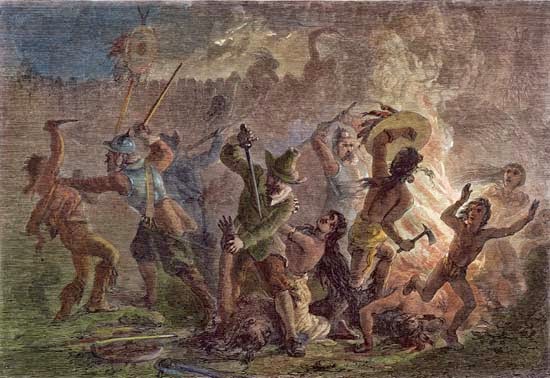
But it seems that, as William B. Newell, a Penobscot Indian and former chairman of the Anthropology department at the University of Connecticut, points out, the first officially declared Thanksgiving Day by the Governor of the then Massachusetts Bay Colony was the day following the slaughtering of a Pequot village of 700 men, women, and children who were celebrating their annual Green Corn Dance, in June 1637 executed under the command of one John Underhill and documented by William Branford.

In fact, a proclamation of such a holiday recorded in Charlestown, Massachusetts, thirty-nine years later, June 20, 1676, refers to the indigenous peoples of this land as “the Enemy” in “the present Warr with the Heathen Natives of this land.” And the governing council of Charlestown, Massachusetts set June 29 to thank the god of the Puritan “pilgrims” for “giving us especially of late with many of our Confederates many signal Advantages against them [the indigenous people],” thankful “when our Enemies are in any measure disappointed or destroyed.”

It first became a national holiday declared such by George Washington in 1789 for November 26. Abraham Lincoln revived the custom in 1863, and Congress decreed the holiday should fall on the fourth Thursday of November in 1941. And so it is, a holiday with antecedents in the remotest times of human history and burdened with national myth and fact, piety and villainy more often than not inextricably intertwined.

Since 1969 or 70 on San Francisco Bay, the day is begun at sunrise with American Indian ceremony at the gathering of the tribes on the island of Alcatraz as reminder of the history of this land — and as rededication to changing its course for the better.

Feasting with family and friends in thanks for the blessings of life, Thanksgiving is a holiday of celebration whose joy is marred by a consciousness of our nation in continual war and destruction of the Earth. The government (we, if we tolerate it) not only wages war unjustly, unlawfully, justifying itself through lies and deceit, but violates the U. S. Constitution and Bill of Rights so that our civil rights and liberties are less and less guaranteed. The wealth of the nation is concentrated in the hands of the one per cent rich and powerful, and most of our people will celebrate this day with less wealth, less security, less freedom, less learning, than thirty-four years ago. And the struggle to create a democracy continues.

In the midst of this pain and exasperation, we must give thanks for the gifts of life and the sustenance of the great Mother the Earth. And for each other, and all our relations the other animals, the plants, the minerals. We give thanks mindful that in our gratitude we must also raise our voices in the name of justice and peace resolved to make amends and undertake healing knowing that gratitude for that which we enjoy at the expense and suffering of our brothers and sisters is blasphemous and unacceptable.


© Rafael Jesús González 2015
Alta California


  -

Saturday, November 21, 2015

Sagittarius

-
-


-
------------Sagitario


El arquero apunta a Júpiter,
----planeta de tantas lunas,
cuya luz se refleja en sus ancas,
y en la punta de topacio de su saeta
brota la llama inconstante del anhelo.
------En cadena de estaño
------lleva pectoral de turquesa
------bruñida de ensueños
---------y apunta
-------------------y apunta
---------y anhela herir al cielo.


-------------------© Rafael Jesús González 2015


-------------Sagittarius


The archer points at Jupiter,
-----planet of many moons
whose light reflects on his haunches,
and on the topaz point of his arrow
bursts the inconstant flame of his desire.
------On a chain of tin
------he wears a medallion of turquoise
------polished by dreams
---------and he points
----------------------and he points
------and desires to wound the sky. 


----------             ------© Rafael Jesús González 2015

-
-

Thursday, November 19, 2015

The Call

-

http://www.norcalclimatemob.net/


--------------La llamada 


¿Qué puedo decir para incitarte
-------a defender la Tierra?
¿Recordarte como se siente el sol?
¿el sabor de la sal, el olor del laurel?
¿El chirrido de grillo en noche de verano,
el arco iris después de lluvia?
--------¿Lo que es amar?
¿Imploraré a tu goce
-----o a tu pavor?
Puede ser terrible la Tierra
en sus tormentas y sus temblores
pero es la medida de cual paraíso
------imaginemos jamás.
Tú y yo moriremos demasiado pronto
-----pero que no siga la vida
----------es más allá de aceptable.
¿Qué puedo decir para que ames la vida
suficiente para que actúes y alces la voz
-----------en su defensa?


---------------------------------- © Rafael Jesús González 2015


(Berkeley Times, 19 noviembre 2015;
derechos reservados del autor)


http://www.norcalclimatemob.net/


--------------The Call 


What can I say to entice you
------to defend the Earth?
Remind you how the sun feels?
The taste of salt, the smell of bay?
a cricket's chirp on a summer night,
the rainbow after rain?
-----What it is to love?
Shall I appeal to your joy
------or to your fear?
Earth can be terrible
in her storms & in her quakes
but she is the measure of any paradise
---------we will ever imagine.
You & I will die all too soon
------but that life will not go on
-----------is beyond accepting.
What can I say to make you love life
enough to act & raise your voice
----------in its defense?


-----------------------------© Rafael Jesús González 2015


(Berkeley Times, November 19, 2015;
author's copyrights.)


http://www.norcalclimatemob.net/

We are most urgently called to bring our art, 
our healing, our joy, our passion, to the 

NorCal Climate Mobilization
in advance of the United Nations Climate Conference in Paris (COP21)

Saturday, November 21, 2015

10:30 AM - Gather at Lake Merritt Amphitheater

12:00 PM - March

1:00 PM - Rally at Frank Ogawa (Oscar Grant) Plaza

Oakland, California

The very Earth and the life she bears are at stake and we must bring all our art, and heart, and healing to save her/us. It is urgent that we gather in huge numbers, that our unified voices be loud and clear, that our fierce love for the Earth and for life be manifested in joy and beauty and clear commitment and determination. The crisis is so dire that nothing less will do. Our mobilization must be huge!

Please share this call widely with all whom you know.

website: to volunteer:

Please endorse as individuals or groups, which you can do from the website, it is free and helps increase social media activity.

So does 'Liking' NCCM on Facebook: 
and Twitter: @CAclimatemob


http://www.norcalclimatemob.net/

Se nos llama urgentemente traer nuestro arte, 
nuestro sanar, nuestra alegría, nuestra pasión a la

NorCal Movilización Climática
en anticipación de las negociaciones de las Naciones Unidas en París (COP21)

sábado 21 de noviembre 2015

10:30 AM - unirnos en el anfiteatro del Lago Merritt

12:00 PM - Marcha

1:00 PM - manifestación en la Plaza Frank Ogawa (Oscar Grant)

Oakland, California


La Tierra misma y la vida que lleva están a puesta y tenemos que traer todo nuestro arte y corazón y sanar para salvarla, para salvarnos. Es urgente que nos reunamos en números inmensos, que nuestras voz unida sea fuerte y clara, que nuestro amor feroz por la Tierra y por la vida se manifieste en alegría y belleza y compromiso y resolución claros. La crisis es tan seria que nada menos servirá. ¡Nuestra movilización tiene que ser inmensa!

Por favor compartir esta llamada ampliamente
con todo mundo que conozca.

website: para ayudar:

Por favor endose como individuos o grupos. Lo podrán hacer en el  website, es gratis y ayudará a aumentar la actividad de los medios sociales.

Tal como lo hará 'Liking' NCCM en Facebook: 
y Twitter: @CAclimatemob


http://www.norcalclimatemob.net/

-

Wednesday, November 11, 2015

Veterans Day


When the First World War officially ended June 28, 1919, the actual fighting had already stopped the eleventh hour of the eleventh day of the eleventh month the previous year. Armistice Day, as it was known, later became a national holiday, and in 1954 (the year I graduated from high school), the name was changed to Veterans Day to honor all U.S. veterans of all wars.

The only veteran of that war, “the war to end all wars
,” I ever knew was my father’s step-father Benjamín Armijo, from New Mexico, an old man who seldom spoke and whom I would on occasion see wearing his cap of The American Legion. (He was also Republican.)

“The war to end all wars” was anything but that and when I was not much more than five, three of my uncles on my mother’s side (Roberto, Armando, Enrique) went off to fight another war, the Second World War.

I missed my uncles and remembered them by their photos on my grandmother’s home altar, very handsome in their uniforms; in the endless rosaries and litanies the women in the family regularly met to pray; and in the three blue stars that hanged in the window.

My uncle Roberto, tío Beto, did not last his second year; he came home and ulcers and los nervios, nerves, were mentioned. My uncle Armando, tío Pana, in the Infantry division or the Cavalry Division (though not one horse was ever ridden into battle in that war), served in the Pacific Theater, and Guadalcanal is a name that in some way sticks in his history. My uncle Enrique, tío Kiki, the youngest, in the Airborne Division, the “Screaming Eagles,” served in the European Theater and parachuted into the taking of Germany.

After that war ended, they came home, tío Pana into a hospital, sick with malaria which affected him throughout the rest of his life; tío Kiki with a malady in the soul not so easily diagnosed, hidden in his quiet humor, gentle ways. All my uncles were gentle men, in all senses of the word. And Beto, Pana, Kiki spoke not at all about their experiences of war in spite of my curiosity and questions which they diverted with a little joke or change of subject. What they had seen, felt was apparently not to be spoken and the family sensed this and respected their reticence. Neither of them joined the Veterans of Foreign Wars that I ever knew.


Enrique González Prieto


The Korean War “broke out”, as they say, as if it were acne, not long after. But as for me, I have never fought in any war, though I joined the U. S. Navy upon graduating from El Paso High School to become a Hospital Corpsman and obtain the G.I. Bill with which to enter Pre-Med studies upon my discharge; two of four years in the Navy I spent in the Marine Corps with the rank of Staff Sergeant. The Korean War had already ended. And though I served closely enough to it to be given the Korea Defense Service Medal and am legally a veteran and eligible to join the VFW, I never did nor do I intend to.

If I consider myself veteran of any war, it would be of the Viet-Nam War, not because I fought in it, far from it, but because I struggled against it. (I counseled conscientious objectors, picketed recruiting offices, marched in the streets.) The war veterans I have most intimately known are from that war, many, if not most, wounded and ill in body (from bullets, shrapnel, agent-orange), wounded and ill in the soul (terror, guilt, shame, hatred putrefying their dreams, tainting their loves.)

I am leery of being asked to honor veterans of almost any war, except as I honor the suffering, the being of every man or woman who ever lived. I am sick of “patriotism” behind which so many scoundrels hide. I am sick of war that has stained almost every year of my life. Given that almost every war the U.S. has waged and wages are invasions of other countries justified with thin pretensions of "defense," I am impatient with fools who ask whether I “support our troops.”

What does it mean to “support our troops”? What is a troop but a herd, a flock, a band? What is a troop but a group of actors whose duty it is not to reason why, but to do and die? In the years I served in the Navy and Marine Corps as a medic, I never took care of a troop; I took care of men who had been wounded and hurt, who cut themselves and bled, who suffered terrible blisters on their feet from long marches, who fell ill sick with high fevers. If to support means to carry the weight of, keep from falling, slipping, or sinking, give courage, faith, help, comfort, strengthen, provide for, bear, endure, tolerate, yes, I did, and do support all men and women unfortunate enough to go to war.

Troops, I do not. If to support means to give approval to, be in favor of, subscribe to, sanction, uphold, then I do not. The decision to make war was/is not theirs to make; troops are what those who make the decisions to war use (to kill and to be killed, to be brutalized into torturers) for their own ends, not for ours, certainly not for the sake of the men and women who constitute the “troops.”

Indeed, I find the question whether I "support our troops" offensive, cynical, hypocritical given that we care so little for our veterans: so many are homeless; find no work; have little care for their wounds, physical and psychological; little for their addictions; many are in prison; a great many commit suicide. This acknowledged, the "patriotism" the question pretends is hollow and blind.

I honor veterans of war the only way in which I know how to honor: with compassion; with respect; with understanding for how they were/are used, misled, indoctrinated, coerced, wasted, hurt, abandoned; with tolerance for their beliefs and justifications; with efforts to see that their wounds, of body and of soul, are treated and healed, their suffering and sacrifice compensated. I never refuse requests for donations to any veterans’ organization that seeks benefits and services for veterans. I honor veterans, men and women; not bands, not troops.

If you look to my window on this day, the flag you will see hanging there will be the rainbow flag of peace. It hangs there in honor of every veteran of any war of any time or place. Indoors, I will light a candle and burn sage, recommit myself to the struggle for justice and for peace. Such is the only way I know in which to honor the veterans (and victims
military or civilian) of war.

Berkeley, November 11, 2007


© Rafael Jesús González 2015


Universal Justice & Peace Flag
  Universal Justice & Peace Flag is licensed under a  
Creative Commons Attribution-ShareAlike 4.0 International License.


Día del Veterano


Cuando la Primera Guerra Mundial oficialmente acabó el 28 de junio 1919, la lucha actual ya había cesado en la oncena hora del onceno día del onceno mes del año anterior. Día del Armisticio, como fue conocida, más tarde se hizo fiesta nacional, y en 1954 (el año en que me gradué de la secundaria), el nombre se le cambió a Día del Veterano para honrar a todo veterano estadounidense de todas las guerras.

El único veterano de esa guerra, “la guerra para acabar con toda guerra,” que jamás conocí era el padrastro de mi padre, Benjamín Armijo, de Nuevo México, un hombre anciano que raras veces hablaba y a quien en ocasión veía llevar la gorra de La legión Americana. (Era también republicano.)

“La guerra para acabar con toda guerra” fue todo menos eso y cuando yo tenía no mucho más de cinco, tres de mis tíos maternos (Roberto, Armando, Enrique) salieron a pelear en otra guerra, la Segunda Guerra Mundial.

Echaba de menos a mis tíos y los recordaba por sus fotos en el altar hogareño de mi abuela, muy guapos en sus uniformes; en los rosarios y letanías sin fin que las mujeres de la familia a menudo se juntaban a rezar; y en las tres estrellas azules que colgaban en la ventana.

Mi tío Roberto, tío Beto, no duró su segundo año; regresó a casa y se mencionaban las úlceras y los nervios. Mi tío Armado, tío Pana, en la División de infantería o la División de caballería (aunque ni un solo caballo jamás fue montado en ninguna batalla de esa guerra) sirvió en el Teatro del Pacífico y el nombre de Guadalcanal de algún modo se pega a su historía. Mi tío Enrique, tío Kiki, el menor, en la División Aérea, “las águilas chillantes,” sirvió en el Teatro Europeo y se lanzó en paracaídas en la toma de Alemania.

Después de que acabó esa guerra regresaron a casa, tío Pana a un hospital enfermo de malaria que le afectó por el resto de la vida; tío Kiki con dolencia del alma no tan fácil de diagnosticar ocultada en su humor suave, modos amables. Todos mis tíos fueron hombres gentiles en todo sentido de la palabra. Y Beto, Pana, Kiki no hablaban nada acerca sus experiencias de la guerra a pesar de mi curiosidad y preguntas que distraían con una pequeña broma o cambio de tema. Lo que habían visto, sentido aparentemente no era para decirse y la familia lo percibía y respetaba su reticencia. Ninguno de ellos se juntó a los Veteranos de Guerras Extranjeras de que yo sepa.


La Guerra Coreana reventó, como dicen, como si fuera el acne, no mucho después. En cuanto a mí, yo nunca he peleado en ninguna guerra aunque me ingresé a la Marina estadounidense graduando de la Escuela secundaria de El Paso para hacerme enfermero y conseguir la beca militar con que empezar mis estudios de medicina cuando acabara mi servicio; dos de los cuatro años en la marina los pasé en la Infantería de marina con el rango de Sargento del personal. La Guerra Coreana ya había acabado. Y aunque serví lo suficientemente aproximado a ella para ser otorgado la Medalla de defensa de Corea y soy legalmente veterano y elegible a juntarme a los VFW [Veteranos de Guerras Extranjeras] nunca lo hice y jamás lo intentaré.

Si me consideraría veterano de ninguna guerra sería de la Guerra de Vietnam, no porque haya peleado en ella sino porque luché en contra de ella. (Aconsejé a objetores de conciencia, puse piquetes a oficinas de recluta, marché en las calles.) Los veteranos de guerra a quien he conocido más íntimamente son los de esa guerra, muchos de ellos, si no la mayor parte, heridos y enfermos de cuerpo (de balas, de metralla, de productos químicos), heridos y enfermos del alma (terror, culpa, vergüenza, odio pudriéndoles los sueños, envenenándoles los cariños.)

Soy sospechoso de que se me pida que honre a veteranos de casi cualquier guerra, excepto como honro el sufrir, el ser de todo hombre o mujer que jamás ha vivido. Estoy harto del “patriotismo” detrás del cual tantos canallas se esconden. Estoy harto de la guerra que ha manchado casi todos los años de mi vida. Especialmente ahora en medio de una guerra más sin justificación, inmoral, ilegal, insoportable, cínica, cruel que la nación hace en Irak, en Afganistán. Soy impaciente de los bobos que me preguntan si no “apoyo a nuestras tropas.”

¿Qué significa “apoyar a nuestras tropas”? ¿Qué cosa es una tropa sino un rebaño, una manada, una banda? ¿Qué es una tropa sino un grupo de actores cuyo deber no es razonar el porque sino cumplir y morir? En los años que serví en la marina y en la infantería de marina como enfermero, nunca cuidé de una tropa; cuidé de hombres heridos y dañados, que se habían herido y sangraban, que sufrían ampollas terribles en los pies debidas a largas marchas, que enfermaban con fiebres altas. Si apoyar significa llevar el peso, impedir caer, resbalar o hundir, dar valor, fe, auxilio, consuelo, fuerza, abastecer, cargar, tolerar, sí, lo hice y apoyo a todos hombres y mujeres tan infelices como para ir a la guerra.

A las tropas, no. Si apoyar significa aprobar, estar en favor, suscribirse, sancionar, entonces no. La decisión de hacer la guerra no es de ellos para hacer; las tropas son lo que esos que hacen las decisiones de guerra usan (para matar y ser matados, para ser brutalizados en torturadores) para sus propios fines, no los nuestros y ni mucho menos los de los hombres y mujeres que constituyen las “tropas.”

En efecto, encuentro la pregunta si "apoyo a nuestras tropas" ofensiva, cínica, hipócrita dado que tan poco cuidamos de nuestros veteranos: muchos están sin techo; no encuentran trabajo; tienen poca atención a sus heridas, físicas y psicológicas; poca a sus adicciones; muchos están en cárcel; muchísimos se suicidan. Reconociendo esto, el "patriotismo" que la pregunta pretende es hueco y ciego.

Honro a los veteranos de la guerra solamente del modo en que sé honrar: con compasión; con respeto; con comprensión de cómo fueron/son usados, engañados, indoctrinados, obligados, desperdiciados, dañados, abandonados; con tolerancia de sus creencias y justificaciones; con esfuerzo para que sus heridas, de cuerpo y alma, se traten y se sanen, su sufrir y sacrificio se recompensen. Nunca me niego a las peticiones por donación a las organizaciones de veteranos que buscan beneficios y servicios para los veteranos. Honro a los veteranos, hombres y mujeres; no a bandas ni a tropas.

Si buscas a mi ventana este día, la bandera que encontrarás allí colgando será la bandera arco iris de la paz. Allí cuelga en honor de todo veterano de cualquier guerra en cualquier época o lugar. Dentro, encenderé una vela y quemaré artemisa y me dedicaré de nuevo a luchar por la justicia y la paz. Tal es el único modo en que sé honrar a los veteranos (y víctimas militares o civiles) de la guerra.


Berkeley, November 11, 2007

© Rafael Jesús González 2015


bandera uiversal de la justicia y la paz
-
-
-
-